
Typically in term-time student accommodation short stay programmes, booking volume and revenue are the default measure of success. But this is an overly simplistic view, as it overlooks the operating cost of servicing each booking. In AY 2025/26, 30+ day bookings represented 11% of all term-time short stay transactions, but generated 54% of all nights sold. Meanwhile, 70% of bookings (those of seven nights or fewer) contributed just 21% of total nights. On a like-for-like basis, this concentration is intensifying year on year: 30+ day stays grew from 52% to 60% of all nights sold. The implication for PBSA operators running term-time short stay programmes is significant: the value and attractiveness of these programmes are increasingly driven by a key cohort of longer bookings, yet most operating models aren’t designed around that reality.
A recent analysis of 30+ day bookings on the Lavanda platform identified a fast-growing segment of term-time demand: students booking dedicated student accommodation for month-long stays on flexible terms, outside the traditional 40-51 week lease structure. That segment grew its share of all term-time bookings by 26% year on year, with an average stay of 60 nights and a median of 46 nights.
The finding raised a follow-on question that may be more commercially significant than the growth trend itself: if a relatively small segment is growing this quickly, what does it already contribute to the overall economics of a term-time short stay programme?
Where the nights actually come from
The instinct in short stay operations – across hospitality, not just PBSA – is to equate activity with value. More bookings, more revenue. But the relationship between booking volume and nights sold is far from linear, and in term-time student accommodation the gap is particularly stark.
Across the Lavanda platform in AY 2025/26, bookings of 30 days or longer accounted for 11% of all term-time transactions. Those bookings generated 54% of all term-time nights sold. One in ten bookings produced more than half the occupancy.
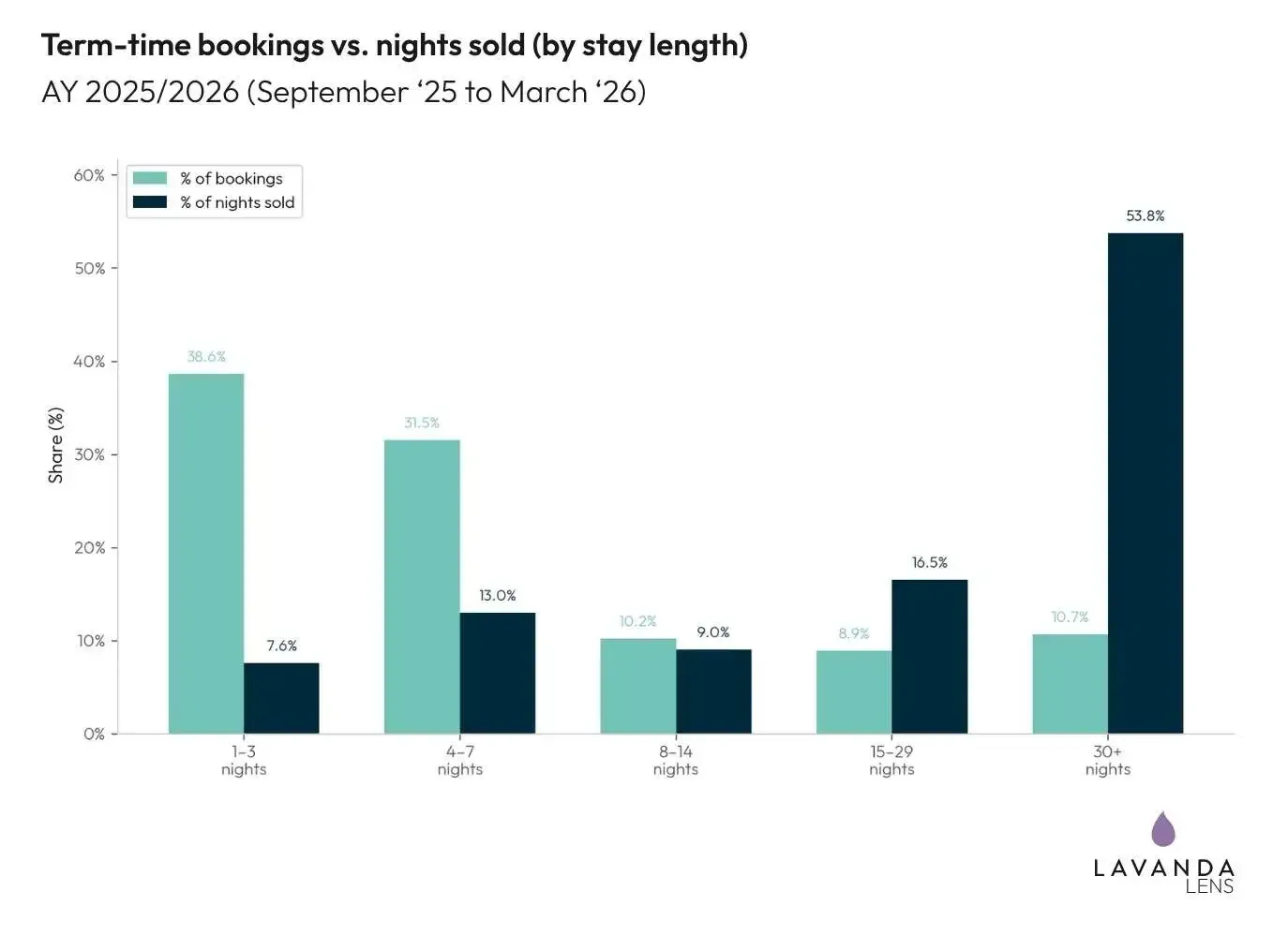
At the other end, stays of seven nights or fewer represented 70% of all bookings but contributed just 21% of nights. These are the stays that dominate the operational workload – the check-ins, the turnovers, the guest communications – yet they account for roughly a fifth of the occupancy outcome.
The middle of the distribution is worth noting too: stays of 14 days or more. These represent 21% of all term-time bookings and delivered 72% of total nights sold. That is a 3.4:1 ratio of occupancy contribution to transactional share.
It is important to note what these figures are and aren’t. They are compositional: proportions of a whole, not absolute volumes. N.B. Lavanda’s portfolio under management has grown significantly year on year, which means absolute booking and night counts reflect both demand trends and inventory expansion. Proportional metrics strip out the portfolio effect entirely. When 11% of bookings produce 54% of nights, that relationship holds whether the platform has a hundred units or ten thousand.
The shift is accelerating
To test whether this concentration is stable or changing, we looked at the first 3 months of 2026 (January to March) where like-for-like data exists for both AY 2024/25 and AY 2025/26.
In AY 2024/25, stays of 30 days or longer accounted for 52% of all nights sold. In the same three months of AY 2025/26, that figure rose to 60%. The proportion of nights generated by stays of seven nights or fewer fell from 21% to 14% over the same period.
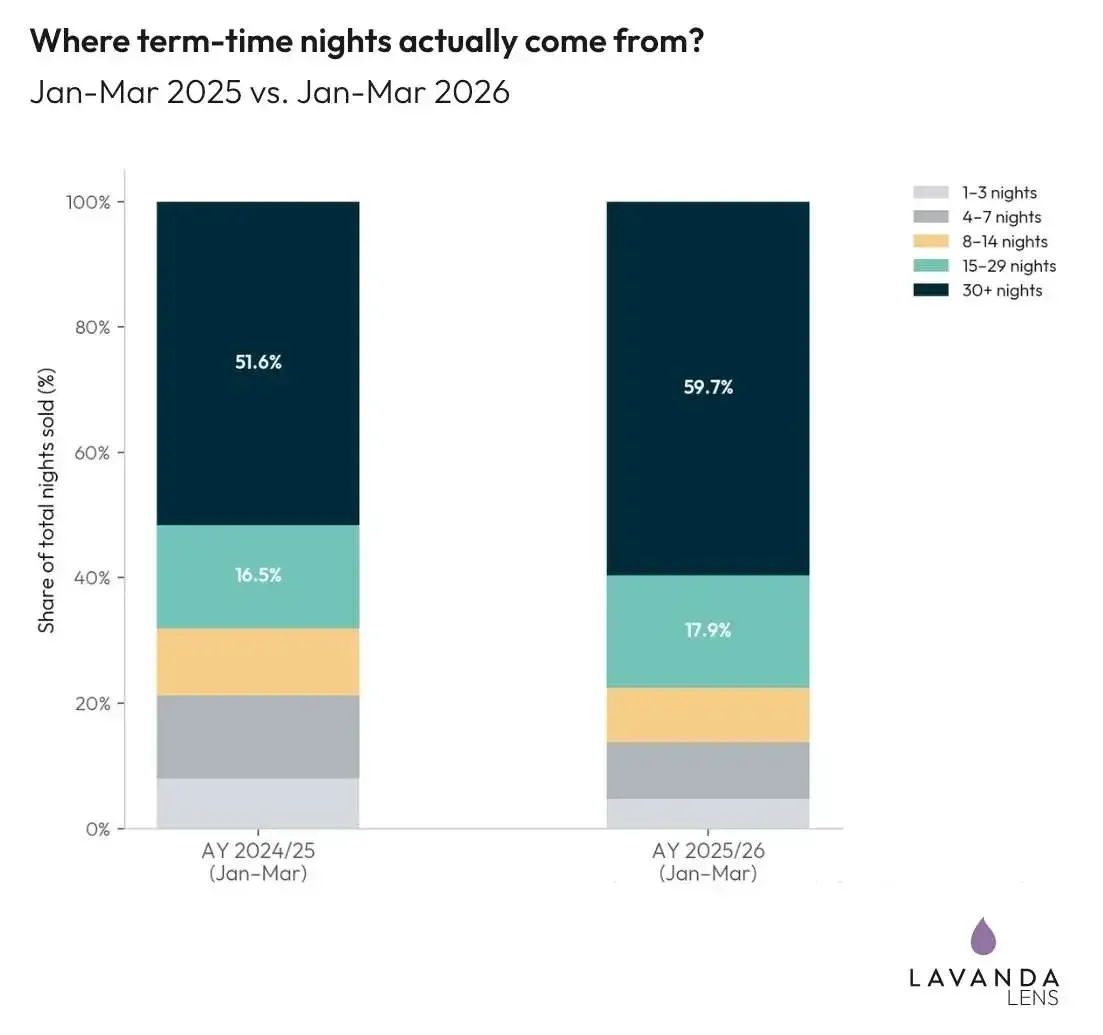
This is not a change in volume. It is a change in the composition of student booking demand. The mix is shifting toward longer stays during the academic term-time, and the pace of that shift is meaningful.
As a reminder, every booking analysed is a student, staying in dedicated student accommodation with “student-only” planning permission. The demand signal is coming from within the student population itself: a growing proportion of students engaging with flexible, term-time accommodation are doing so for stays measured in months, not nights. That pattern is more consistent with placement semesters, exchange programmes, and non-standard academic schedules than with the casual campus visits often associated with the commuter student narrative.
The operational consequence
Concentration has a direct operational implication that tends to be under appreciated.
Every booking, regardless of duration, triggers a fixed operational cycle: pre-arrival communications, access provisioning, check-in, mid-stay management, check-out, turnover, etc. The cost of this cycle does not scale proportionally with the length of stay. A 60-night booking does not require thirty times the operational effort of a 2-night stay. In practice, the incremental operational cost beyond the first few days is close to zero.
This means the relevant measure of operational efficiency is not bookings per unit or nights per unit, but turnovers per occupied night.
In AY 2025/26, term-time short stays on the Lavanda platform averaged one turnover for every 12.2 nights of occupancy. In AY 2024/25 the equivalent figure was 10.0 – meaning term-time programmes have become 22% more operationally efficient year on year, driven entirely by the compositional shift toward longer stays, without any deliberate operational intervention.
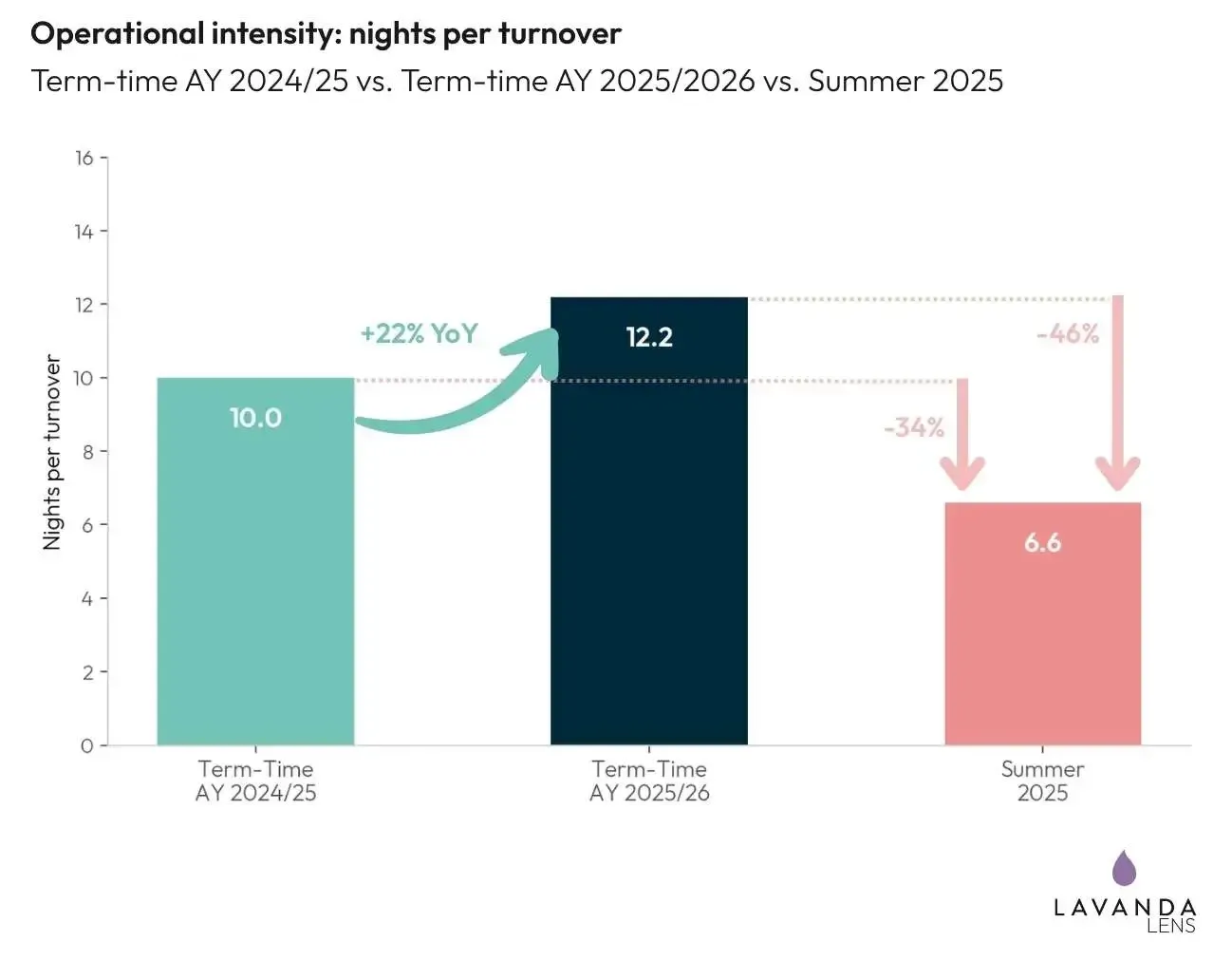
For context, summer short stay programmes across the same portfolio averaged one turnover per 6.6 nights. Term-time requires 45% fewer turnover cycles per occupied night than summer – a gap that’s widening as the term-time demand mix continues to lengthen.
This is not an argument against summer programmes, which serve a fundamentally different purpose and target a very different demand profile. But it does challenge the common assumption that term-time short stays are operationally burdensome relative to the revenue they generate. The data suggests the opposite: the operational cost per occupied night during term-time is falling, because the bookings that contribute most of the occupancy require the least operational intervention per night.
The strategic implication
If the majority of term-time occupancy – and by extension, the majority of term-time short stay revenue – comes from a small proportion of bookings, the operational model and pricing strategy should reflect that.
Most term-time short stay programmes in PBSA are designed around volume: maximise availability windows, price to fill gaps, process bookings efficiently at scale. That approach is well-suited to the 70% of bookings that are seven nights or fewer. But it is not designed to capture, retain, or optimise the 10% that generate the majority of the economic outcome.
The longer-stay segment needs a different approach. Pricing structures that reward duration rather than penalising it. Availability management that protects windows long enough for 30+ day stays rather than fragmenting them into short-stay slots. Yield measurement that accounts for turnover cost, not just nightly rate. And, perhaps most significantly, a recognition that this segment represents a distinct product within the short stay programme, not an incidental by-product of it.
The concentration is already there. It is increasing. And it is a structural feature of how students are engaging with flexible, term-time accommodation. The question for operators is whether their programmes are set up to capture that value, or whether they’re optimising for the 70% of bookings that produce 21% of the result.
Get in touch if you’d like a free illustration of term-time short stay demand for your PBSA or university accommodation portfolio.