When AndSoul set out to build London’s most ambitious co-living brand, they knew early on that their technology would either make or break the model. Running short-stay hospitality and long-stay residential simultaneously under one roof is genuinely complex. Most property management platforms are built for one tenure type. AndSoul needed something different.
Today we are delighted to announce that AndSoul has selected Lavanda OpenPMS as the operational backbone of its growing London portfolio, a partnership that reflects exactly the kind of institutional-grade, flex living strategy our platform was purpose-built to support.
Who is AndSoul?
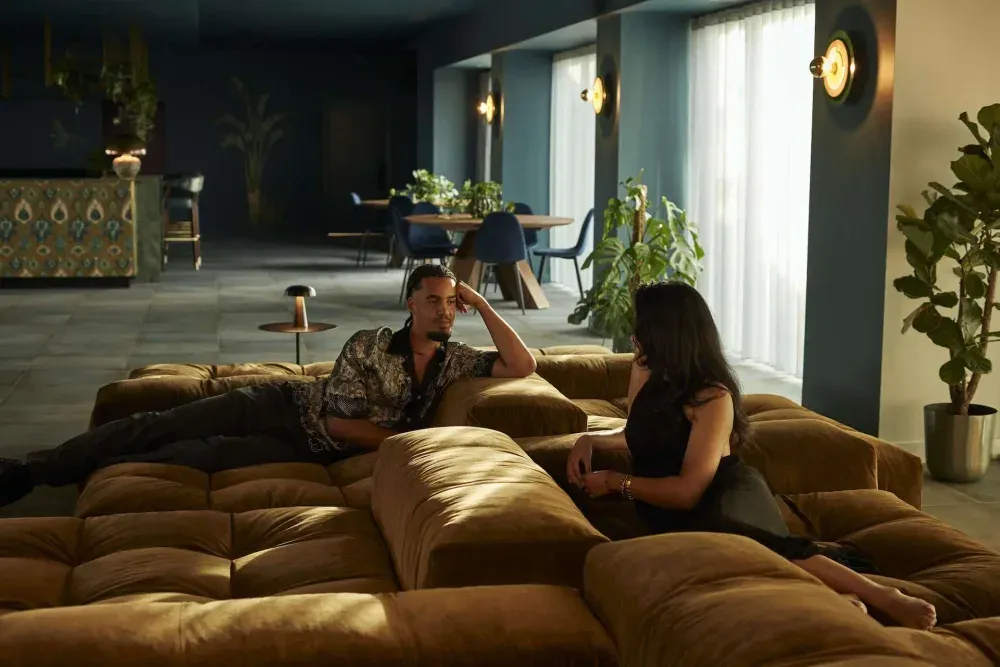
AndSoul is a London co-living, hybrid hospitality and wellness brand founded by Reza Merchant, who also founded The Collective. The business operates on a clear thesis: that Londoners deserve a more connected way to live, and that residential buildings can be designed around genuine community rather than pure accommodation.
Its live portfolio spans Shoreditch and Southall, with two further London schemes in development and a pipeline targeting five to seven assets within seven years. What makes AndSoul distinctive is its flex living model: members can stay for a single night, a few months, or multiple years, with the same premium residential and wellness experience throughout. That breadth is what creates the operational challenge. And it is precisely that challenge that Lavanda OpenPMS was built to solve.
The flex living problem that most platforms cannot handle
Multi-tenure operators running a genuine flex living model face a problem most property management software quietly sidesteps: the data, processes and distribution logic for a one-night OTA booking look nothing like those for a 12-month lease. Most platforms pick a side. Operators end up stitching together two or three separate systems, which means manual reconciliation, fragmented reporting and a finance function buried in spreadsheets.
AndSoul put it directly:
Running long-stay residential and short-stay hospitality within the same building is operationally demanding, and our previous systems were built for one tenure type only. We needed a single platform to manage the full spectrum of our operation: housekeeping, maintenance, revenue reporting and OTA distribution, all in one place.
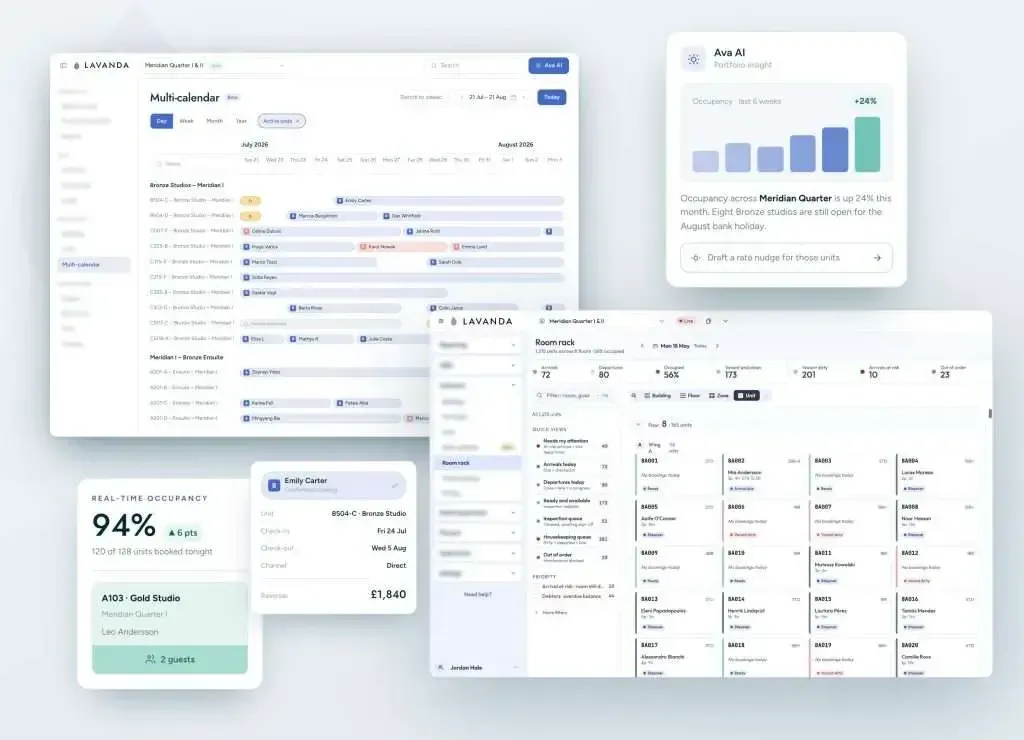
Lavanda OpenPMS brings all of this into a single, unified system. Performance, occupancy and dynamic pricing sit alongside contracts, invoices and rent collection. Reporting and analytics cover every tenure type in one view. The resident experience layer connects both short and long-stay members to the same on-site team through a dedicated app. And the booking engine handles everything from a one-night stay distributed across Airbnb, Booking.com and Expedia, through to multi-year residential leases, without any manual handoff between systems.
A composable platform built for scale
One of the reasons AndSoul selected Lavanda was architecture. OpenPMS is built on an API-first, composable foundation that integrates cleanly into enterprise technology stacks, rather than forcing operators to rip out their existing tools and adopt a monolithic replacement. Operators can price individual components according to their specific needs, connect their own tooling, and build out their technology stack over time.
For a brand scaling towards seven London assets while reporting to institutional investors, this matters enormously:
For our investors, what matters is daily RevPAR, ticket resolution times and occupancy across all stay types. Lavanda gives us the reporting to hold ourselves accountable against all of it.
This composable approach also positions Lavanda at the forefront of the shift toward agentic AI workflows, where modular, open systems are becoming the prerequisite for automation at scale.
AI capabilities that go beyond the PMS
The operational platform is only part of what AndSoul is getting from this partnership. Lavanda’s AI-first commercial layer is increasingly central to how operators like AndSoul drive commercial performance.
Lavanda’s AI-enabled vetting engine automates the guest screening process, reducing manual workload without lowering the standards that protect a community-first brand like AndSoul. AI-powered discovery capabilities are built for the way people increasingly search for accommodation: through LLM-based platforms like ChatGPT, Claude and Google Gemini, not just through traditional search engines and OTA listings. And post-booking, AI-driven renewal prompts and personalised upsells mean the revenue management function runs proactively rather than reactively.
AndSoul framed it well:
Lavanda gives us the operational platform and the AI capabilities to do that without adding complexity or cost. Their architecture is built for how businesses like ours actually operate: composable, open, easy to integrate with, and their product roadmap is pointed squarely at where the industry is heading.
Why this partnership matters for institutional residential
The AndSoul partnership is a clear signal of where institutional residential real estate is heading. The most ambitious operators are no longer choosing between short-stay hospitality and long-stay residential. They are running both, because the flex living model serves a wider range of members, optimises occupancy across cycles, and builds community across stay types in ways that single-tenure models simply cannot.
That complexity demands a platform that was designed for it from the start, not adapted to fit. Lavanda’s customer base already includes Greystar, Unite, Blackstone and Hines. AndSoul joins a community of operators who have concluded that running a genuinely institutional residential business requires a genuinely institutional-grade platform.
And from Lavanda:
AndSoul is exactly the kind of operator Lavanda was built for. Their model, community-first co-living, hospitality-grade standards and a deliberate flex living strategy all running under one roof, represents where the best of institutional residential is heading. It demands a platform that can handle the operational complexity without ever letting it show.