
The 30+ day flexible accommodation segment is a growing category of student housing that provides month-long stays with flexible timing during academic term-time, distinct from both traditional 40-51 week PBSA contracts and short-stay hospitality. This segment addresses the gap between rigid term-length commitments and tactical weekend visits, serving students on placements, exchange programmes, or those managing non-standard study patterns.
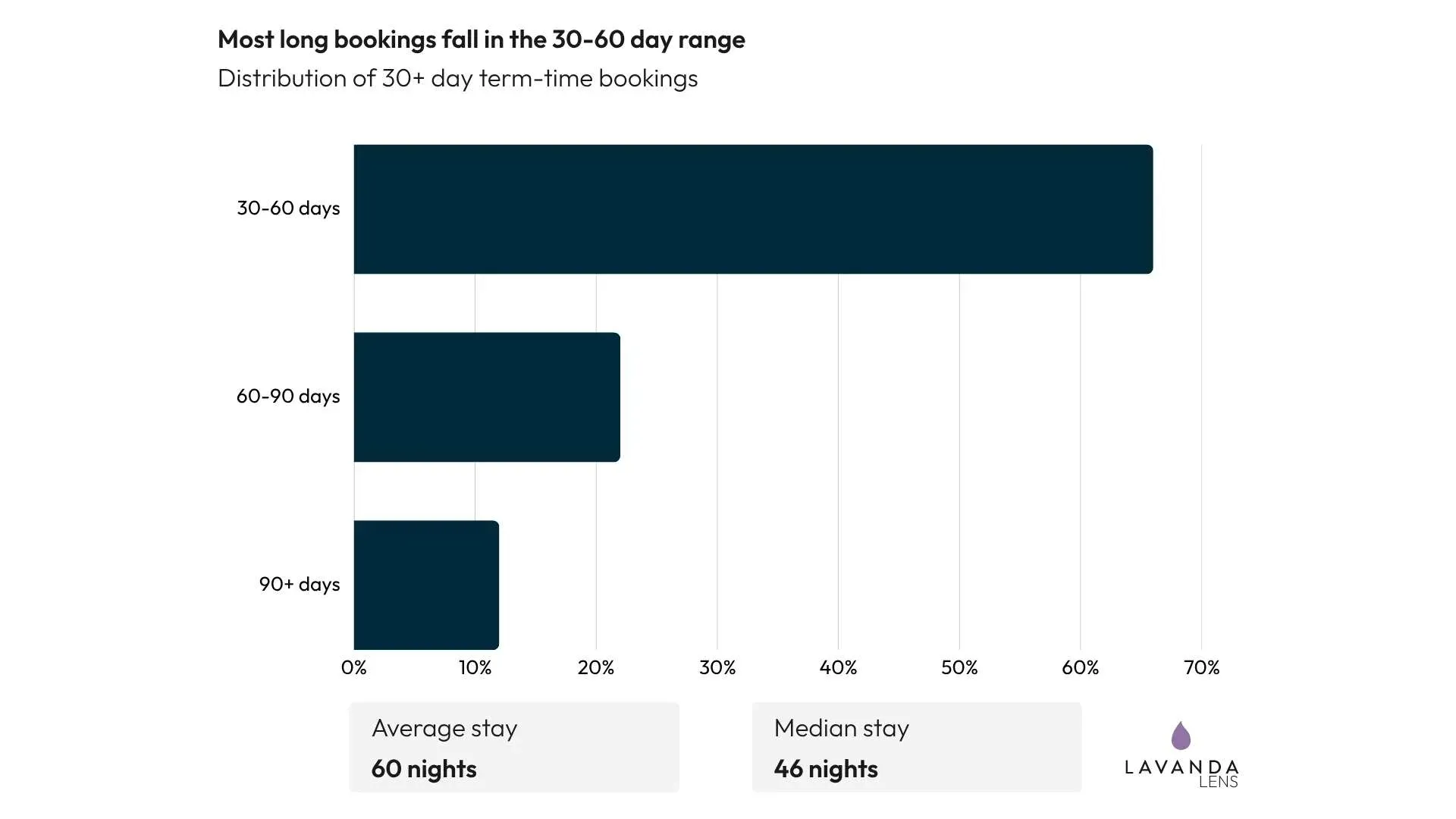
The segment’s key characteristics include average stays of 60 nights (median 46 nights), lower operational intensity than typical hospitality short stays due to fewer turnovers, higher margins than summer programmes, and year-on-year growth of 26% in market share from AY24/25 (8.5%) to AY25/26 (10.7%) year-to-date. Most bookings (64%) fall within the 30-60 day range, with meaningful clusters at 60-90 days and beyond 90 days.
This segment differs from commuter student accommodation, which typically involves regular weekly or fortnightly patterns. Instead, it represents structural demand for substantial stays with flexible timing that matches actual study patterns rather than traditional academic calendars. Lavanda platform data shows this growth occurred organically without dedicated optimisation, suggesting significant untapped potential for operators who actively target this segment.
The industry narrative is clear: 31% of UK 18-year-olds who secured university places in 2025 said they intended to live at home, up from 30% in 2024 and 22% a decade ago (UCAS). That’s 89,510 students planning to live at home – a 7% increase on the previous year. From there the story writes itself: students are commuting to save money, creating demand for short, tactical stays around campus visits.
Our term-time booking data does not, however, match this story. Instead it points to a more nuanced phenomenon.
In AY24/25 (September 2024 – May 2025), student accommodation bookings of 30 days or longer represented 8.5% of term-time demand. In AY25/26 to date (September 2025 – March 2026), that figure has jumped to 10.7%. That’s a 26% increase in market share YoY. In volume terms, 30+ day bookings more than doubled between the two periods.
 And these aren’t short stays by any definition. The average length of stay is 60 nights. The median is 46 nights. The majority fall between 30-60 days, with meaningful clusters at 60-90 days, and even beyond 90 days.
What we’re actually seeing
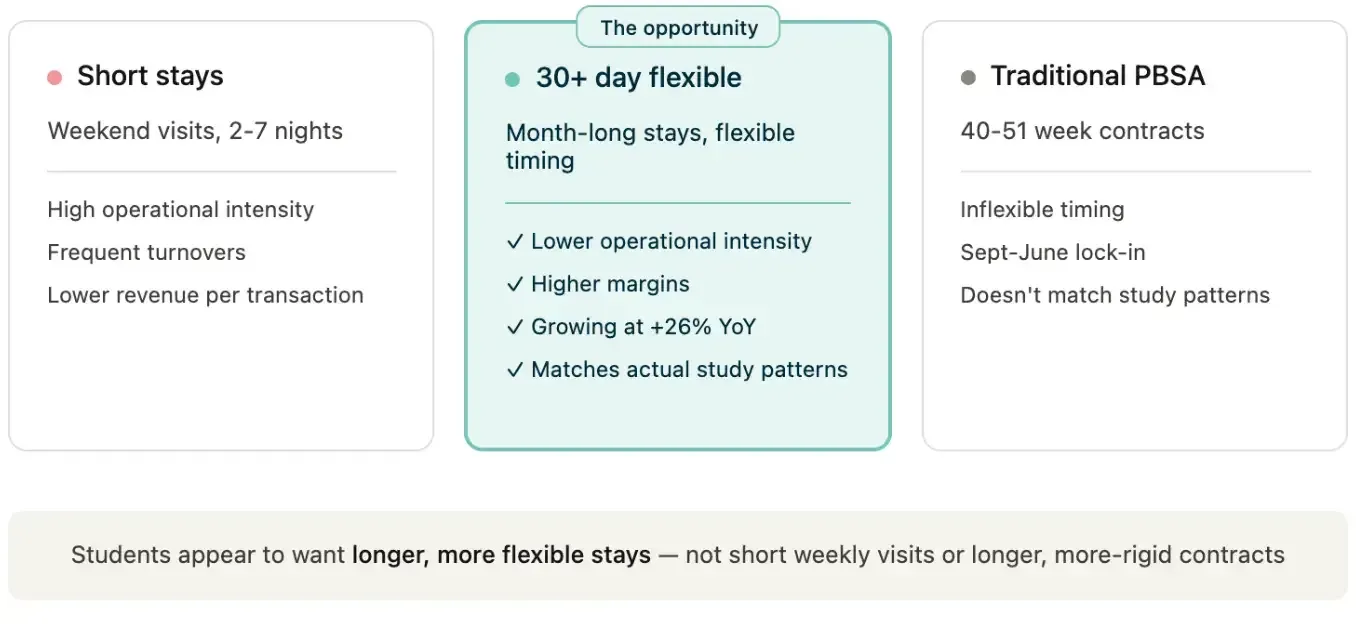
The 30+ day segment sits in an odd gap. It’s too long for hospitality operators to typically care about. It’s too flexible for traditional PBSA to accommodate. And yet it’s growing faster than anything else in the term-time booking mix.
These bookings are operationally attractive. Fewer turnovers per night sold. Higher revenue per transaction. Lower operational friction relative to short stays. They’re exactly what you’d want to build a business around if you were set up to capture them.
So who’s booking these 60-night stays on flexible terms? Likely students on placements. Exchange students arriving mid-term. International students with unusual arrival dates. Students managing complicated personal situations. Maybe even commuter students testing a return to full-time campus life without committing to a 40-week contract.
The point is that they want flexibility, but they still need accommodation for real stretches of time.
The optimisation gap
This growth has happened completely organically. There’s been no systematic attempt to go after this segment. No pricing strategy specifically designed to target month-long stays. No outreach to university placement offices. No attempts or tools to convert a one-off 45-day booking into a recurring relationship across multiple terms.
The opportunity here isn’t hidden. It’s just been sitting in the shadow of two louder narratives: short-stay flexibility on one side, and the traditional PBSA product on the other. The 30+ day segment doesn’t fit neatly into either category, so it hasn’t received proportional attention.
But the growth rate tells you everything you need to know. When a segment doubles in volume without anyone actively optimising for it, that’s not a niche. That’s structural demand finding the path of least resistance.
What this means for student accommodation operators going forward
The commuter student trend is real. But viewing it through the lens of weekend stays and weekly visits might be missing the actual accommodation need. Some students don’t want to commute – they want to be on or near campus, just not locked into a September-to-June contract that doesn’t match their actual study pattern.
Flexible accommodation products that can deliver stays measured in months, not nights, look like the segment with the clearest tailwinds. Lower operational intensity than short stays. Higher margins than heavily discounted summer programmes. And growing at double-digit rates completely organically without any dedicated focus.
The real question isn’t whether this opportunity exists. It’s whether operators will build around it before someone else does.
Get in touch if you’d like to get a free illustration of term-time short stay demand for your PBSA or university accommodation portfolio.